Introduction
Time saved is the easy pitch and the easy number to drop on a slide, but whether an AI tool for competitive intelligence is any good comes down to harder questions: can you trust it, can you trace it, does it actually change a decision or just give someone more to read, and underneath all of that, was it built on anything solid to begin with.
Efficiency is real and worth having, but the trouble starts when speed is the only thing you measure, because then you can build something fast that quietly makes you worse at the actual job. Three things get missed almost every time, and a fourth sits underneath all of them.
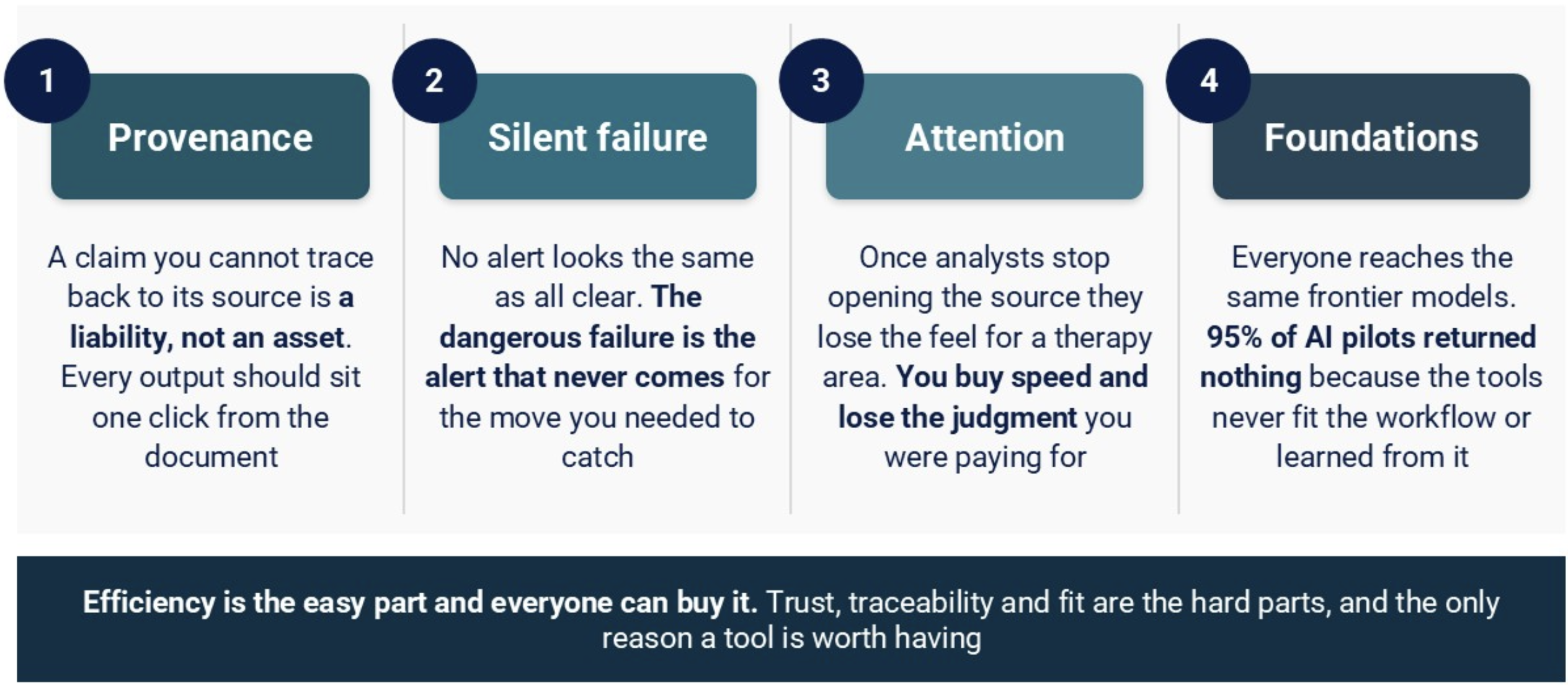
Provenance: a claim you cannot trace back to its source is a liability rather than an asset
In a regulated world, a claim you cannot trace back to its source is a liability rather than an asset, which is why everything a tool tells you should sit one click away from the document it came from. This is not a theoretical worry. In 2026 a Big Four firm had to pull a published report offline after researchers ran down its citations and found most of them were fabricated, misattributed or led nowhere, including one that pointed to a consultancy report which, when anyone went looking, simply did not exist. It all sounded authoritative, but there was nothing behind it, and if a tool cannot show you where a claim came from, you cannot check it, you cannot defend it, and you should not be staking a client recommendation on it.
Silent failure: the dangerous alert is the one that never comes
A tool that stops covering a source, or quietly gets worse, almost never tells you, and no alert looks exactly the same as all clear. The dangerous failure in monitoring is not the false alarm you can roll your eyes at and dismiss, but the alert that never comes for the one competitor move you needed to catch. Good tools are built to flag their own blind spots, but most just go quiet.
Attention: you can gain speed and lose the judgment you were paying for
Once analysts learn to trust the summary they stop opening the source, and within a few months they lose the feel for a therapy area, the instinct that used to make them stop and frown at the one thing that did not fit. You gain speed and lose the exact judgment that made the function worth paying for, which is a bad trade, and an easy one to make without noticing you have made it.
Foundations: the model inside the tool is the least important part of it
The quality of an AI tool for competitive intelligence has almost nothing to do with which model is bolted inside it. Everyone can reach the same frontier models this week, and a better one next week, so what separates a useful tool from a slick demo is what you feed it and where it sits in the real work.
The evidence here is getting hard to ignore. A 2025 MIT study of enterprise AI looked at 300 deployments and found that about 95% of company pilots delivered no measurable financial return, not because the models were weak but because the tools never fit into real workflows or learned from them. The same study found that AI built or bought with a specialist partner worked roughly twice as often as the versions companies tried to build alone, so the deciding factor was not the model but the fit and the foundations.
Competitive intelligence is no different. The value sits in which sources you monitor, how they are structured and tagged, how signals get connected over time so a small move today links back to a pattern from six months ago, and how the output lands in front of the right person at the moment a decision is live. None of that demos well, but all of it is where the advantage actually lives.
Conclusions
The thread through all four is the same. Build the tool around the analyst’s judgment and the workflow it lives in, not around the model, and not as a quiet way to justify fewer good people. Efficiency is the easy part, and everyone can buy it, but trust, traceability and fit are the hard parts, and they are the only reason a tool is worth having.
The tests are practical ones. How do you check for what a tool is not catching, rather than only checking what it produces? Beyond time saved, what does good actually look like here, and can you measure it? And if your advantage depends on the model rather than your data and workflow, what happens the day a competitor licenses the same model?
These are the questions we hold ourselves to at Eradigm, and they shape what we are building with our partner Pharosyn, from signal acquisition and first-pass write-up today towards end-to-end monitoring in which the data, the context and the workflow are the asset rather than the model. The model will keep changing, probably again by the time you finish reading this, so the value has to sit somewhere more durable than that.