
Introduction
Finding information, aggregating it at speed, keeping it current and keeping a whole team on top of it: that genuinely was the bottleneck in competitive intelligence. AI has largely dissolved it, and in doing so it has dragged the harder problem into the open, which is deciding what any of it means.
In this piece we look at what AI has genuinely solved in competitive intelligence, where it fails in ways that are easy to miss, and why deciding what matters remains a human judgment that has to be built for deliberately.
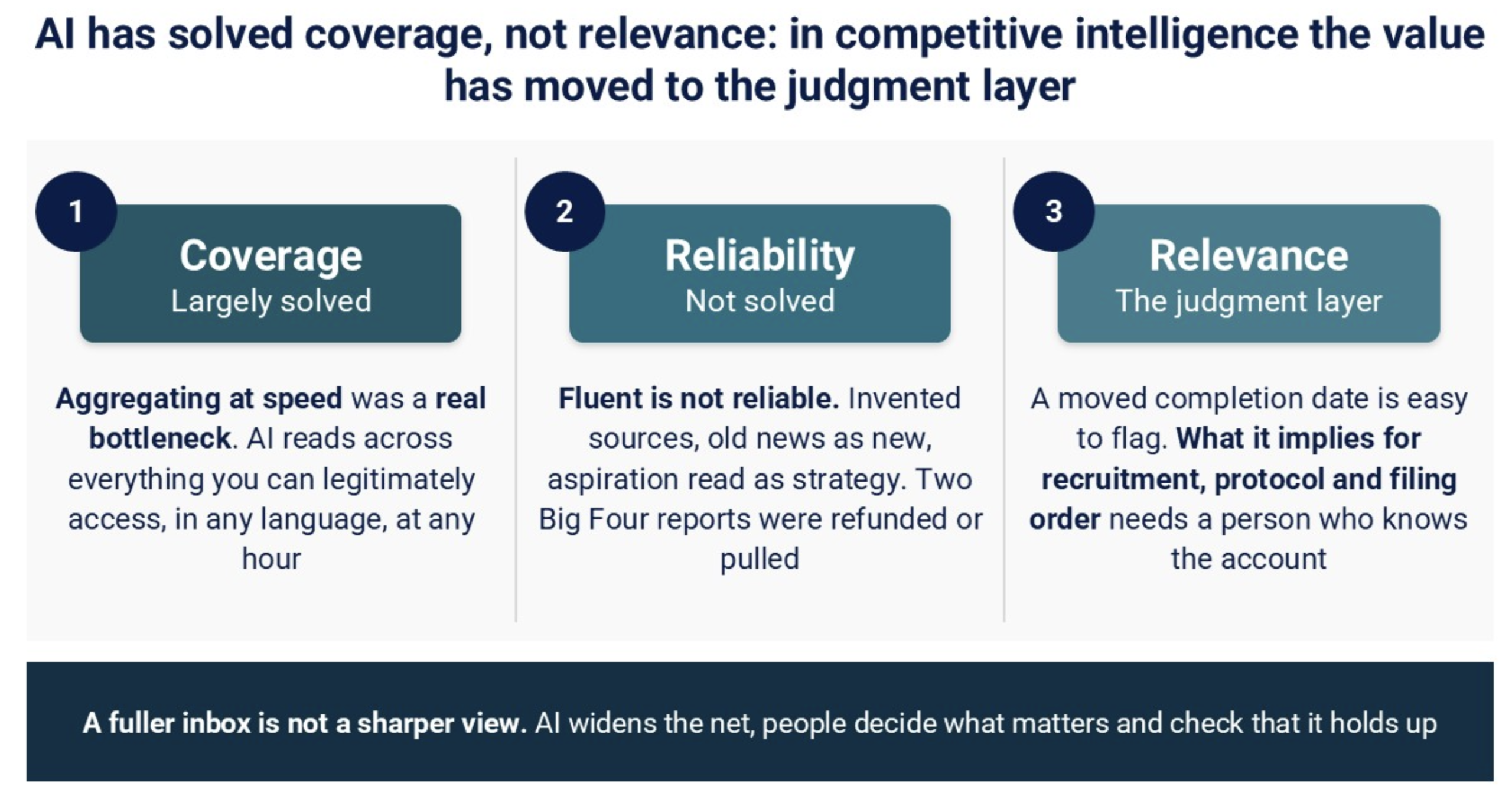
Coverage: aggregating information at speed was a real bottleneck, and AI has largely dissolved it
Consider the scale. PubMed alone holds more than 40 million biomedical citations and grows by roughly a million records a year, and once you add company filings, investor calls, conference abstracts, regulatory postings, patent filings and trial registries, no analyst is reading their way through it. For years the job was to try anyway, because the item you missed was always the one that mattered, whether that was an abstract buried on day three of a congress, a quiet wording change on a label, or a line in an earnings call hinting at a shift in strategy. Miss one and you could miss the story.
This is exactly the kind of work AI is built for. It reads across everything you can legitimately give it access to, in any language, and it does not get tired, bored or sloppy at 4pm on a Friday, flagging what changed, grouping the related bits and handing back a clean summary in seconds. Coverage and aggregation, the thing that used to keep analysts at their desks long after everyone else had gone home, is close to a solved problem.
Reliability: fluent and reliable are not the same thing, and telling them apart takes subject knowledge
There is a sharper version of this problem worth saying out loud. AI does not just miss what matters; sometimes it makes things up and delivers them with a completely straight face. In 2025 a Big Four firm had to refund part of its fee to the Australian government after a report it handed over turned out to cite academic papers that did not exist, along with a quote from a court judgment that was never said. The report read beautifully, but its sources were invented, and it was not a one-off: weeks later a second report from the same firm, this time for a Canadian provincial government, hit the same wall, and the same problem has since surfaced elsewhere in professional services.
These were not two interns and a free chatbot but major firms shipping a finished report to a client, which makes the lesson directly relevant to anyone whose job is producing evidence-based advice. The lesson is not that AI cannot be trusted and should be shoved in a drawer, but that fluent and reliable are not the same thing, and telling them apart takes someone who actually knows the subject.
Fabrication is only the most visible failure. The subtler ones show up far more often in our work: old news resurfacing as though it broke this morning, an aspiration voiced at a conference or on an earnings call written up as if it were a committed plan, a modest line extension inflated into a strategic pivot. In competitive intelligence, a confident summary of a competitor move is worth almost nothing until a person who understands the therapy area has checked whether it is real, whether it is new, whether the evidence actually supports the framing, and whether it really moves the needle.
Relevance: judgment is the product, and the context a model needs has to be built in deliberately
The trouble is that coverage was never the same thing as insight. Clients rarely ask what happened last week; they ask whether any of it changes what they should do next, and that is a different question, one that needs context: the shape of the client portfolio, the bet they are quietly making this year, the three things they already know cold, and the single signal, out of hundreds, that would really move the needle. A model does not arrive holding any of that, though the interesting part is that it can be given it. Teams that stop at the chatbox never get there, while teams that invest in data and context architecture, feeding in years of competitor coverage alongside the client’s own questions and narratives, unlock a level of value the first group never sees. Relevance is a judgment, and judgment starts with knowing why someone is asking.
Take something as small as a primary completion date moving by four months. Flagging the change is trivial. Working out whether it points to faster recruitment, a protocol amendment, a site expansion or a quiet problem, and then whether it pulls a competitor readout into the same window as your own, is the actual job. The change is the easy part, and what it implies is the work.
This is where the human part stops being a nice sentiment and becomes the actual product. An analyst who knows the account can look at 400 signals and tell you the two that matter, and why, whereas AI will hand you a neat summary of all 400, and a summary of everything is not intelligence. It is just a longer thing to read, and every so often it is confidently, fluently wrong.
Conclusions
None of this is an argument against using AI, because we use it every day and the coverage it buys us is real. It is an argument for being honest about the division of labour: AI widens the net and does the reading no team could keep up with on its own, while people decide what is worth keeping, check that it holds up, and turn it into something a client can act on. The failure we watch for is a team mistaking a fuller inbox for a sharper view.
The questions worth holding onto are practical ones. How do you tell whether AI is adding insight, or just adding volume with better formatting? When a signal that mattered slips through, or a fabricated one slips in, who is accountable, the model or the person who trusted it? And because models keep getting better at reasoning, and the line between what they can judge and what still needs a person keeps moving, how do you keep testing where that line actually sits rather than assuming it stayed where it was last year?
This is the question we keep coming back to at Eradigm, and it shapes what we are building with our partner Pharosyn. Today that means signal acquisition and first-pass write-up, with the analyst’s judgment layered on top, and the direction is end-to-end monitoring, where coverage, context and output connect instead of sitting in separate tools and the analyst spends their time on the part only they can do. The goal was never to read faster, but to be right about what matters.